Why Your Event Platform Choice Is a Brand Decision, Not Just a Tech One
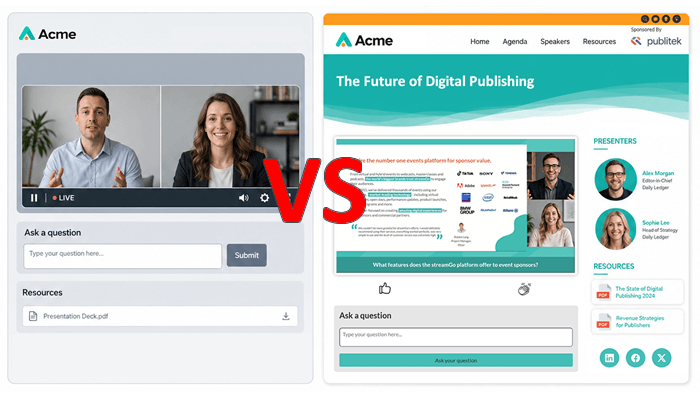
Every August, event and marketing teams start looking at their platform contracts. Summer is quiet enough to think clearly, September is too close to switch without disruption, and the pressure of the autumn event season makes the case for getting this right now rather than later.
The evaluation process usually goes the same way. Feature comparisons get built in spreadsheets. Pricing tiers get screenshotted. A few demos get booked. The questions on the list are reasonable ones: does it integrate with our CRM, what is the support model like, can it handle the audience size we need?
What rarely makes the list is the question that probably matters most: what will this platform do to how our brand comes across to attendees?
The experience your platform delivers is your brand
Every time someone registers for one of your events, receives a reminder email, joins a live session, or accesses an on-demand recording, they are having a brand experience.
If that registration page is visibly built on someone else's platform, if the reminder emails come from a domain that is not yours, if the session window looks like a generic video conferencing tool with your logo dropped in the top corner, then the implicit message to your audience is that this is not really yours. It is something you are borrowing.
That might feel like a small thing next to a feature comparison spreadsheet. It is not. Audiences have attended enough online events to have calibrated expectations. They notice when an experience feels cohesive and when it feels bolted together. And what they notice affects how they feel about the company running it, even if they would struggle to articulate exactly why.
What "branded" actually means
The word gets used loosely in platform marketing, so it is worth being specific about what brand control should look like across the event lifecycle.
The registration page is the first touchpoint most attendees will have with your event, and by extension your company. It should sit on your domain, match your website design, and contain nothing that signals the platform behind it.
Reminder and confirmation emails are often overlooked in platform evaluations but they are a repeated touchpoint in the days before your event. Who they come from, what they look like, and whether they feel like part of your communications or a generic system message all affect attendance rates and first impressions. Our guide to improving event registrations with multiple touchpoints covers why this communication sequence matters — and the platform you choose determines how much control you have over it.
The live event environment is where most teams focus their evaluation, rightly so, but the question to ask is not just whether you can add your logo. Can you control colours, typography, layout, and the overall look of the session window well enough that an attendee would not know which platform they were on? That is the bar. Anything short of it is co-branding rather than white-label.
On-demand access is the touchpoint teams most often leave to the platform defaults, partly because it feels like an afterthought once the live event is done. But for a significant portion of your audience, the people who registered and did not attend live or who want to rewatch a specific section, the on-demand experience is the only one they will have. The value of making on-demand content work properly extends beyond convenience. It is another surface where your brand either shows up consistently or defers to the platform.
The problem with generic event experiences
There is a practical consequence to running events on platforms with limited brand control, beyond the aesthetic one.
When your webinar looks and feels like every other webinar your audience attends, you make it harder for them to build a mental association between the experience and your company. The content might be excellent. The speaker might be compelling. But if the event environment is visually indistinguishable from a competitor's webinar or a generic training session, the brand impression does not accumulate in the way it should.
This matters more as event fatigue becomes a genuine factor in audience behaviour. Audiences are making more deliberate decisions about which events are worth their time, and the ones that feel like a considered, polished experience from a company that takes its brand seriously will consistently do better than the ones that feel interchangeable, regardless of topic quality.
There is a trust dimension too. A secure and well-considered platform that your audience reaches through your own domain, with your branding throughout builds familiarity. One that sends attendees to a third-party URL they do not recognise introduces friction, however small. Over a series of events, that friction compounds.
What to look for in a platform evaluation
Once you accept that brand experience belongs on the evaluation list alongside features and pricing, you need specific things to actually check.
Custom domain hosting. Your events should live on your domain, not a subdomain of the platform's. Ask to see a live example before the demo ends, not a mockup.
Email communication. The sending name, design, and content of reminder and follow-up emails should all sit within your control. At the point where a prospect receives an event invitation from you, they should have no reason to suspect a third-party platform is involved.
The session environment. Ask the platform to walk you through the full range of what you can and cannot change in the attendee-facing interface. If the demo environment looks more like the platform's brand than yours, that answer is useful information.
On-demand hosting. A proper video library with your branding, chapter navigation, and searchable content is a different product from a folder of recordings accessed via a generic link. Ask what the experience looks like for someone who registered but did not attend live, since that is often the majority of your list.
Post-event data flow. Check how event engagement data reaches your CRM and what your follow-up communications actually look like from the recipient's side. The platform should make those messages feel like a continuation of your brand, not a system notification.
The tech still matters
None of this means a platform with strong branding but poor reliability, limited engagement features, or weak integrations is the right choice. The shortlist of webinar platforms worth evaluating in 2026 is not long, and the differences in technical capability between the serious options are real.
But most platforms that have been around long enough to be worth considering can handle a reliable stream, a moderated Q&A, and a poll. The differentiator between them is increasingly less about whether the core features work and more about the depth of control they give you over what your audience actually experiences.
If two platforms can both run your events technically, the one that makes every attendee touchpoint feel like yours is the stronger choice. The feature comparison will not show you that. The right demo questions will.
Questions to ask before you sign
Get answers to these during the demo rather than in a follow-up email. Can you show me a live event running on a custom domain, with the platform branding completely absent? What do the reminder emails look like, and who do they come from? What can I not change about the attendee-facing interface? What does the on-demand experience look like for someone who registered but did not show up live?
The platforms with clear answers to those questions are the ones worth shortlisting.
Inspired for your next online event?
See the streamGo platform in action!