
Beyond Registrations: Turning Webinar Data into Revenue

Share
A webinar registration total tells you how well the invitation performed. It does not tell you whether the event worked.
For publishers, that distinction matters. A webinar is not simply a live broadcast with a form attached. It can be an editorial product, a source of first-party audience insight, a sponsor campaign and a long-term on-demand asset.
Yet many post-event reports still stop at registrations, attendees and perhaps average viewing time. Useful, certainly, but hardly the full story. It is the measurement equivalent of reviewing an article using only its page views.
Publishers already have something advertisers value: a credible relationship with a defined professional audience. The commercial opportunity is to make that relationship measurable without compromising editorial standards or audience trust.
That means looking at event data in layers.
The five layers of webinar data

A useful webinar dataset combines five different types of signal. Each answers a different question for editorial, audience-development and commercial teams.
1. Registration data: who showed an interest?
Registration data provides the starting point for understanding demand. Alongside basic contact information, publishers might collect organisation, job role, seniority, sector, company size or a relevant business challenge.
The important word is relevant. A registration form should gather information that improves the experience or supports an agreed commercial purpose, not ask for someone’s corporate life story before allowing them to watch a 30-minute discussion.
Registration data can help teams understand:
- Which audience segments the subject attracted
- Whether promotion reached the intended sectors and roles
- How registrations were distributed across channels
- Which topics appeal to new audiences versus existing subscribers
- Whether the eventual audience matched the sponsor’s target profile
It is also the first point at which expectations should be set clearly. If attendee information may be shared with a sponsor, this needs appropriate consent, transparency and internal data-governance review.
2. Attendance data: who moved from interest to action?
Registrations indicate intent. Attendance reveals stronger intent.
The registration-to-attendance rate is useful, but the pattern behind it is more instructive. Look at when people joined, how long they stayed, whether they returned and whether they watched live or on demand.
For audience-development teams, this can expose friction in the journey. A large gap between registrations and attendance may point to timing, reminder messaging, an unclear proposition or simply an overambitious duration.
For commercial teams, attendance data helps distinguish between someone who completed a form and someone who gave meaningful time to the subject. Those are not equivalent signals and should not be reported as though they are.
3. Engagement data: what did people actually do?
Attendance is not the same as attention.
Engagement data may include poll responses, submitted questions, chat activity, resource downloads, calls-to-action, reactions, searches and points at which viewers leave. streamGo’s reporting suite, for example, tracks live and on-demand interactions including Q&A, polls, surveys, searches, CTA clicks, downloads and audience drop-off.
These behaviours add context to the headcount.
A question can reveal a practical challenge. A poll response can show how the market is approaching an issue. A resource download may indicate a desire to explore the subject further. A drop-off point may suggest that a session became repetitive, drifted away from its promise or encountered a technical problem.
Individually, these signals are not proof of buying intent. Collectively, they help build a much more useful picture of audience needs.
4. Content data: which ideas earned attention?
Publishers should analyse the webinar as content, not merely as an event.
Which questions kept recurring? Which speaker arguments prompted a reaction? Which sections were replayed or skipped? Which terms did on-demand viewers search for? Where did attention fall away?
These findings can inform:
- Follow-up articles and newsletters
- Future webinar subjects
- Research projects and surveys
- Conference agendas
- Subscriber propositions
- Commercial content packages
AI can accelerate this work. streamGo’s post-event insight tools can generate session summaries, identify speaker highlights and common questions, and present engagement and poll information. AI-generated chapters can also make recordings easier to navigate.
However, AI should support editorial judgement rather than replace it. A summary can identify repeated themes; it cannot decide whether those themes are genuinely important, surprising or suitable for publication. That remains a job for people who understand the market. Editors may be relieved to hear they have not yet been replaced by a particularly enthusiastic spreadsheet.
5. Outcome data: what happened next?
This is the layer most likely to connect a webinar with revenue, and often the hardest to measure.
Outcomes might include:
- On-demand views after the live session
- Newsletter subscriptions
- Further content consumption
- Demo or information requests
- Sales-qualified leads
- Sponsor follow-up engagement
- Renewed or expanded sponsorship
- Influenced opportunities recorded in the CRM
Not every webinar should be judged on immediate pipeline. A thought-leadership session may be designed to improve awareness or establish authority. A lead-generation webinar may have a much more direct conversion objective.
The measurement model should follow the commercial proposition. If the sponsor bought category association and audience engagement, reporting only form fills is inadequate. If the campaign promised qualified leads, a report full of aggregate viewing figures will not rescue it.
What editorial and commercial teams can learn together
Webinar data is most valuable when it is not kept in departmental drawers.
Editorial teams can identify emerging questions, knowledge gaps and language used by the audience. Commercial teams can see which sectors, accounts and themes generated engagement. Product teams can understand how people navigate the event and on-demand experience. Audience-development teams can refine segmentation, promotion and follow-up.
There must still be a firm boundary between editorial decisions and sponsor influence. A sponsor should not determine editorial conclusions simply because it funded the programme. But aggregated, appropriately governed audience insight can help both parties understand the market more clearly.
A practical post-event review should bring these teams together and ask:
- Did we attract the intended audience?
- What held their attention?
- What did they ask for?
- What should we create next?
- What can be reported responsibly to the sponsor?
- Which signals should enter our marketing or sales systems?
That final question matters. Data becomes more useful when it can move into the systems where follow-up happens. streamGo supports integrations with platforms including HubSpot, Salesforce, Marketo and Zapier, allowing registration and engagement information to feed into relevant workflows rather than languishing in a CSV called final-report-v7-really-final.csv.
Give sponsors evidence, not a data dump
Sponsors usually need a clear account of audience quality, campaign delivery and engagement. They do not need 19 spreadsheet tabs with no explanation.
A useful sponsor report should connect performance to the original objectives. It might show:
- Total registrations and unique attendees
- Live and on-demand viewing
- Audience profile against agreed targeting criteria
- Viewing duration and retention
- Poll, Q&A and CTA participation
- Resource downloads
- Popular topics and recurring questions
- Agreed follow-up actions
- Methodology, definitions and relevant limitations
Context is essential. Define what counts as an attendee, an on-demand viewer and an engagement. Separate unique people from total sessions. Distinguish sponsor-generated leads from the wider audience. Avoid presenting every click as commercial intent.
This clarity is increasingly important as media buyers expect inventory and performance to be easier to understand and analyse. The wider publishing debate is no longer just about reach; it is about making audience value legible to advertisers.
The on-demand recording is a product, not an archive
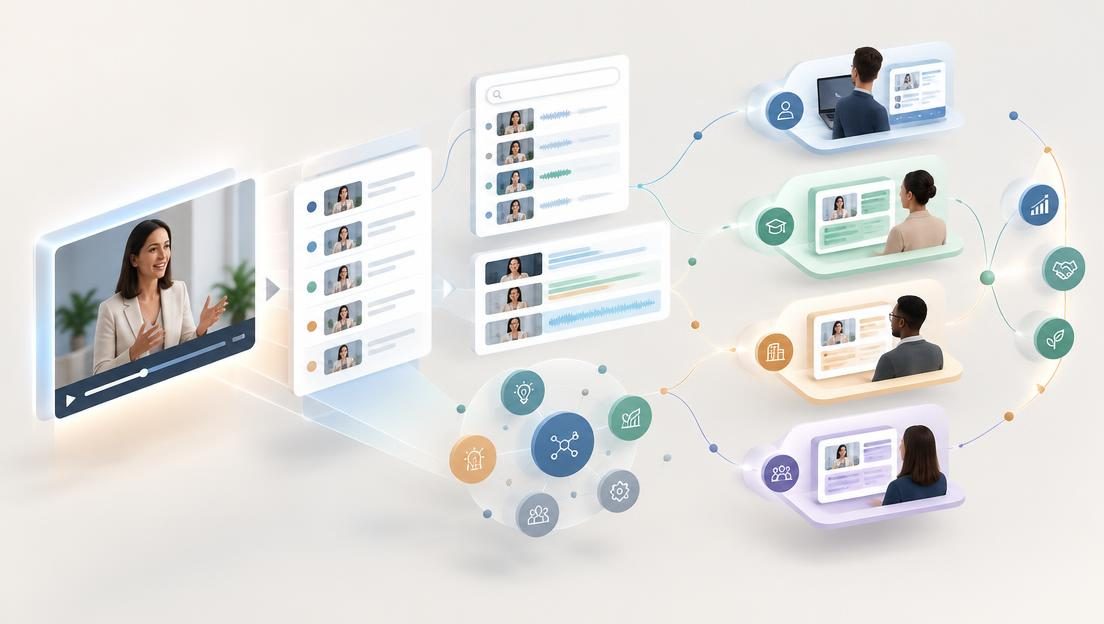
The commercial life of a webinar should not end when the host says goodbye.
A recording can continue to attract viewers, support subscriptions, generate leads and provide evidence of lasting sponsor value. But placing a full video on an unsearchable archive page is not much of an on-demand strategy.
Treat the event platform more like a content management system. As explored in Your Event Platform Is a CMS in Disguise, event content benefits from structured pages, strong metadata, clear navigation, calls-to-action and integration with the rest of the publisher’s digital estate.
Searchable video, captions and topic-based chapters make individual ideas easier to find. A curated library can organise sessions by subject, sector, format or sponsor programme. This turns isolated broadcasts into an expanding body of useful specialist content.
On-demand behaviour should also be included in campaign reporting. In streamGo’s Cognitive Media Group case study, the publisher identifies automated on-demand delivery, reporting and content monetisation as important parts of the value it creates for its teams and clients.
A practical sponsor-reporting checklist
Before sending the post-event report, check that it includes:
- The campaign objective and agreed success measures
- Registration, attendance and on-demand figures shown separately
- Clear definitions for every principal metric
- Audience profile compared with the intended target
- Viewing duration, retention and relevant drop-off points
- Poll, Q&A, download and CTA results
- The most popular themes and recurring audience questions
- Qualitative insight alongside numerical results
- Agreed lead-sharing and consent rules
- Any data limitations or tracking gaps
- Recommended follow-up content or activity
- A date for reviewing longer-term outcomes
Registrations remain useful. They are simply the first line of the story.
Publishers that connect audience, engagement, content and outcome data can create better editorial products, clearer sponsor reporting and more durable commercial assets. The aim is not to collect every possible datapoint. It is to capture the right signals, interpret them properly and use them to improve what happens next.
To explore the available analytics, integrations and post-event insight tools, see streamGo’s reporting suite.
Inspired for your next online event?
See the streamGo platform in action!


